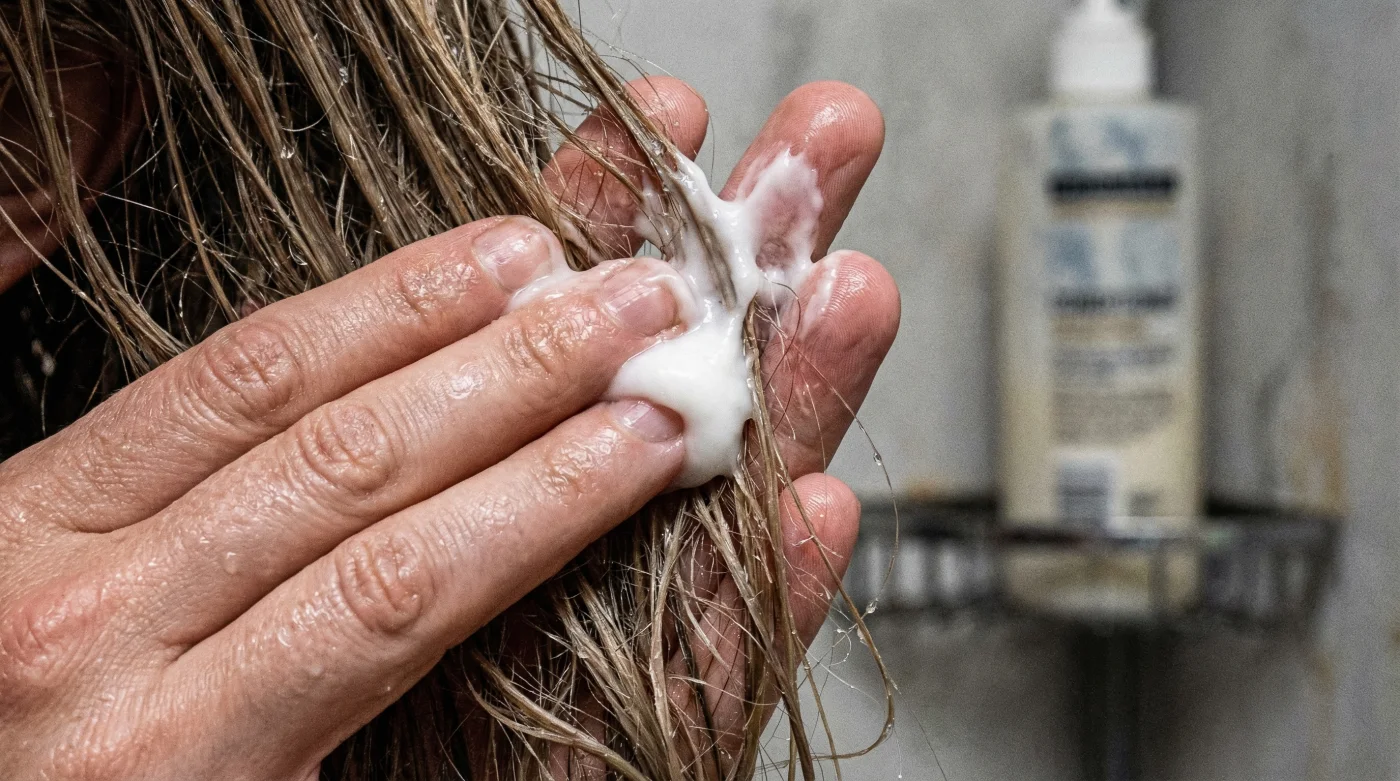
It might feel like the ultimate haircare sin, but skipping your conditioner is actually the secret weapon to unlocking the full potential of molecular repair. For years, we have been programmed to believe that no wash day is complete without sealing the cuticle with a rich conditioner, yet this ingrained habit is creating an invisible barrier that sabotages your most expensive treatments. By applying a traditional conditioner before your bio-active mask, you are essentially wrapping your hair in a protective raincoat that repels the very peptide chains trying to save it.
The science of hair repair has evolved beyond surface-level patching to internal structural engineering. Advanced molecular treatments require a clear, unobstructed path to the hair’s cortex to reconnect broken keratin chains. When you condition first, you deposit occlusive agents—silicones, oils, and cationic polymers—that coat the hair shaft. This film effectively blocks the K18Peptide™ from penetrating deep enough to reverse damage, rendering the treatment significantly less effective. To get the results you paid for, you must temporarily break the rules of traditional haircare.
The Physics of Occlusion: Why Conditioner is the Obstacle
To understand why order matters, you must visualize the microscopic architecture of a damaged hair strand. Traditional conditioners act as surface sealants; their primary function is to smooth the cuticle and reduce friction. While this makes hair feel soft immediately, it creates a hydrophobic (water-repelling) layer. Molecular repair treatments operate on a completely different biological premise: they are designed to travel into the hair, not sit on top of it.
The K18 molecule utilizes biomimetics to recognize and repair broken polypeptide chains. If the cuticle is sealed shut by the low pH of a conditioner, or physically blocked by heavy conditioning agents, the peptide cannot enter the inner structure. It sits uselessly on the surface, washing away the next time you rinse. The following table illustrates the conflicting mechanisms of action between standard conditioning and molecular repair.
Comparison: Surface Conditioning vs. Molecular Repair
| Feature | Traditional Conditioner | K18 Molecular Mask |
|---|---|---|
| Primary Location | Cuticle (Surface Layer) | Cortex (Inner Core) |
| Mechanism | Fills gaps with oils/silicones (Patching) | Reconnects broken keratin chains (Rebuilding) |
| Interaction | Creates an occlusive film | Requires a clean, open path |
| Durability | Washes out over time | Permanent structural change |
Once you understand that conditioning films act as a bouncer at the door of your hair’s cortex, the necessity of a ‘naked’ canvas becomes clear.
The Scientific Environment: pH and Penetration
The efficacy of the K18 treatment is heavily reliant on the pH environment of the hair shaft during application. Shampoos generally have a higher pH, which slightly swells the hair cuticle and lifts the overlapping scales. This is the optimal state for peptide penetration. Conditioners are formulated with a low pH (acidity) specifically to snap those scales shut tight.
By skipping conditioner and applying the mask directly to shampooed, towel-dried hair, you leverage that slightly swollen state to allow the sh-Oligopeptide-78 to slip between the cuticle scales and access the medulla and cortex. Inside, it mimics the natural structure of keratin building blocks, reconnecting disulfide bonds broken by bleach, heat, and chemical services. The data below highlights the critical relationship between pH levels and absorption capability.
Scientific Data: pH Levels & Cuticle State
| Product Category | Typical pH Range | Effect on Hair Cuticle | Peptide Accessibility |
|---|---|---|---|
| Clarifying Shampoo | 7.0 – 9.0 | Swells and Opens | High (Optimal) |
| Standard Shampoo | 5.5 – 6.5 | Slightly Opens/Cleans | Moderate to High |
| K18 Mask | 5.0 – 6.0 | Optimized for stability | Active Penetration Phase |
| Conditioner | 3.5 – 4.5 | Contracts and Closes | Blocked (Zero) |
- Silk bonnets replace cotton pillowcases to stop breakage during sleep cycles
- Tight braids worn past six weeks permanently damage your follicle roots
- Rosemary oil applied to scalps twice weekly restores thinning edges immediately
- Dry shampoo usage three days straight clogs follicles and stalls growth
- Fermented rice water rinses solidify hair protein bonds for massive growth
The Protocol: Precision Application for Maximum Load
Applying this treatment requires a shift in your wash-day psychology. You are not “conditioning” in the traditional sense; you are administering a clinical dosage of repair agents. The water content in your hair also plays a pivotal role. If the hair is soaking wet, the product is diluted, and the water barrier prevents the peptide from making contact with the keratin chains. Conversely, if the hair is bone dry, the delivery system cannot distribute effectively.
The “damp” state is the sweet spot. After shampooing (and skipping conditioner), you must towel dry thoroughly until the hair is damp but not dripping. This ensures the peptide is undiluted and can travel via the remaining moisture into the hair shaft. Once applied, the four-minute wait time is non-negotiable; this is the window where the peptide polymerizes and sets the structure.
Diagnostic: Is Your Application Failing?
- Symptom: Hair feels sticky or heavy after drying.
Cause: Product overdose. You likely used too much product for your hair density. - Symptom: No visible improvement in elasticity.
Cause: Occlusion barrier. Did you use a conditioner or a 2-in-1 shampoo beforehand? - Symptom: White residue on the hair.
Cause: Lack of emulsification. Rub the product vigorously in palms until it turns white before applying.
Mastering the application volume is just as critical as the timing; more product does not equal better results if the pathway is blocked.
Dosing Guide: Customizing for Texture and Density
Because K18 is highly concentrated, standard conditioning logic (“more is better”) does not apply. Using too much can lead to protein overload symptoms or a tacky texture, while using too little results in incomplete coverage. The goal is to coat the strands with just enough peptide to facilitate repair without leaving excess residue on the surface.
Below is a dosing structure based on hair type and length. Note that 1 pump averages about 1ml of product. Start conservatively; you can always add more, but you cannot remove it once the 4-minute activation period begins.
The Peptide Dosing Matrix
| Hair Type / Length | Fine / Thin Hair | Medium Density | Thick / Coarse Hair |
|---|---|---|---|
| Short (Chin Length) | 1 Pump | 1 – 2 Pumps | 2 Pumps |
| Medium (Shoulder Length) | 1 – 2 Pumps | 2 Pumps | 2 – 3 Pumps |
| Long (Mid-Back +) | 2 Pumps | 3 Pumps | 3 – 4 Pumps |
| Application Technique | Focus on ends, sparingly on mids. | Even distribution ends to roots. | Section hair to ensure saturation. |
Once the four minutes are up and the molecular bonds have been re-established, you regain full freedom to apply styling products or even a leave-in conditioner if you need extra slip.
Conclusion: Trusting the Biomimetic Process
The urge to condition immediately after shampooing is a hard habit to break, but the results of a properly executed peptide treatment are undeniable. By removing the conditioner barrier, you allow the K18Peptide™ to function as intended: a biomimetic architect rebuilding your hair from the inside out. This isn’t about skipping a step; it’s about reordering your routine to prioritize structural integrity over superficial softness.
Remember, the “no conditioner” rule applies only before the mask. After the crucial four-minute activation window, the repair is permanent and locked in. At that point, you can layer whatever styling products your hair desires, knowing the core structure is stronger than it was before you stepped into the shower.
Read More