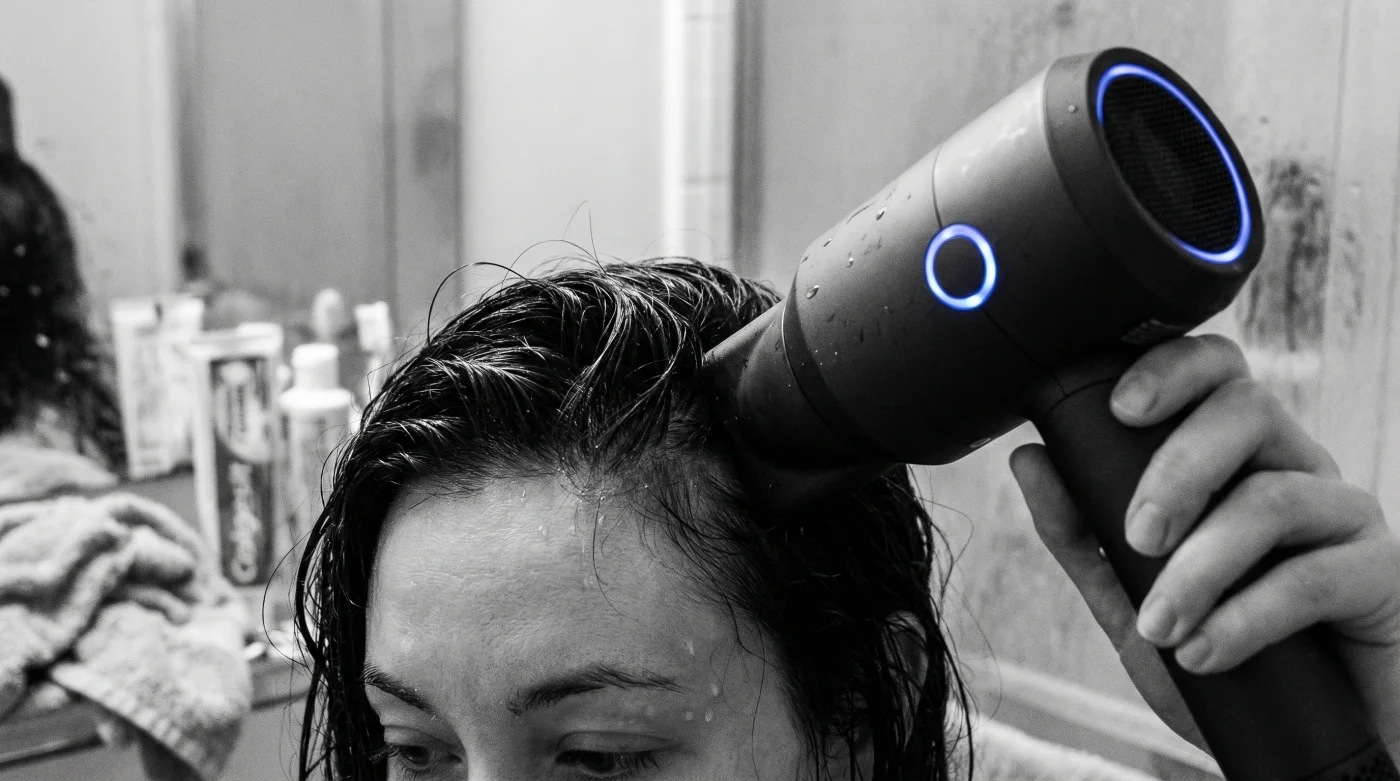
For decades, the pursuit of the perfect blowout has come with a dangerous, unspoken trade-off: the inevitable sacrifice of scalp health for hair volume. We have all experienced the sudden, sharp recoil when a dryer gets too close, or the lingering dryness that follows a high-heat styling session. Most users focus entirely on the strands, ignoring the fact that the scalp is a complex extension of facial skin that requires preservation. But a new shift in hardware engineering has introduced a ‘hidden habit’ into the styling routine—one that requires zero conscious effort from the user but fundamentally alters the biological impact of hair drying.
This breakthrough does not rely on better motors or higher wattage, but rather on a technology typically reserved for autonomous vehicles and industrial mapping. By integrating an invisible field of surveillance between the device and your head, this new tool creates a dynamic thermal shield. It effectively ‘sees’ the proximity of your skin and adjusts its output faster than human reflexes ever could. If you have been struggling with retention, breakage, or chronic dryness, the solution might not be in your conditioner, but in the sensors monitoring your movements.
The Architecture of Scalp Protect Mode
The core of this innovation lies in the Dyson Supersonic Nural and its proprietary network of sensors. Unlike traditional dryers that blast a constant stream of unregulated heat regardless of distance, the Nural utilizes a specific Time of Flight sensor. This sensor emits an invisible infrared beam to measure the distance between the device and your hair, adjusting the temperature to maintain a target of 131°F (55°C) at the scalp—the scientifically determined optimum for drying without causing thermal trauma to the stratum corneum.
This feature, known as Scalp Protect mode, is automatically activated when the compatible attachments are clicked into place. As you move the dryer closer to your roots for lift, the heat instantly drops. As you pull away to dry the lengths, the heat ramps back up to your preset preference. This fluid modulation ensures that the microbiome of the scalp remains intact, preventing the inflammation that often leads to thinning hair. To understand who needs this physical modification the most, we must analyze the specific hair profiles that benefit from thermal regulation.
Table 1: Thermal Sensitivity & User Benefit Profile
| Hair/Scalp Type | The Thermal Risk | Nural Sensor Advantage |
|---|---|---|
| Fine or Thinning Hair | High susceptibility to heat-induced breakage and follicle stress. | Maintains 131°F limit to prevent protein denaturation at the root. |
| Bleached/Chemically Treated | Compromised cuticle layer; scalp is often sensitized from chemical burns. | Prevents ‘hot spots’ that exacerbate chemical sensitivity and dryness. |
| Sensitive/Dry Scalp | Prone to flaking and inflammation (Seborrheic dermatitis triggers). | Preserves natural sebum production by avoiding desiccation. |
However, the protective mechanism is not just internal; it provides real-time visual feedback to the user, creating a new standard for interactive beauty tech.
Decoding the ‘Time of Flight’ Mechanism
- Silk bonnets replace cotton pillowcases to stop breakage during sleep cycles
- Tight braids worn past six weeks permanently damage your follicle roots
- Rosemary oil applied to scalps twice weekly restores thinning edges immediately
- Dry shampoo usage three days straight clogs follicles and stalls growth
- Fermented rice water rinses solidify hair protein bonds for massive growth
The dosing of heat is critical here. Scientific studies suggest that temperatures exceeding 140°F on the scalp can damage the lipid barrier. The Nural is programmed to never breach the safety threshold when in proximity mode. Below is the technical breakdown of how the sensor modulates energy output based on physical distance.
Table 2: Proximity-to-Heat Logic (Dosing Data)
| Distance from Scalp | Heat Output Action | LED Visual Indicator |
|---|---|---|
| Far Range (> 4 inches) | Maximum Heat (Default High Setting) | Red (High Heat) |
| Mid Range (1-4 inches) | Moderate Ramp-down | Orange (Medium Heat) |
| Close Range (< 1 inch) | Instant drop to 131°F (55°C) | Yellow (Cool/Safe) |
Understanding these indicators is essential, but recognizing the signs of past damage is the first step toward rehabilitation.
Diagnostic: Is Your Barrier Already Compromised?
Before integrating the Dyson Nural into your routine, it is vital to assess the current state of your scalp health. Chronic heat exposure often masquerades as other dermatological issues. If you notice the following symptoms, your current drying method may be the culprit:
- Symptom: Tightness post-shower.
Cause: Transepidermal water loss caused by excessive evaporation rates. - Symptom: Excessive oil production by midday.
Cause: The ‘Rebound Effect’—the scalp overproducing sebum to compensate for heat-induced stripping. - Symptom: Redness at the hairline.
Cause: Direct thermal erythema from holding the nozzle too close to the forehead.
By utilizing the accelerometer-based ‘Pause Detect’ feature, the dryer also identifies when you set it down to section your hair, cutting the heater and reducing airflow to silence. This prevents passive heat accumulation in the bathroom environment and saves energy. But how does this stack up against standard high-end dryers? The progression plan below outlines what to look for when upgrading your tools.
Table 3: The Quality Guide (Standard vs. Nural Tech)
| Feature Criteria | Standard Ionic Dryer | Dyson Supersonic Nural |
|---|---|---|
| Temperature Control | Static settings (Low, Med, High). | Dynamic, distance-adjusted modulation. |
| Attachment Logic | Manual adjustments required. | Attachment Learning: Remembers the last heat/speed used for each specific nozzle. |
| Motion Sensitivity | None (Always on). | Pause Detect: Auto-standby when placed on a surface. |
With these advancements, the definition of a ‘good blow dry’ has shifted from pure aesthetic speed to long-term dermatological preservation.
Expert Verdict on Scalp Preservation
The integration of Time of Flight sensors represents a pivotal moment where beauty hardware acknowledges biological limits. Experts in trichology agree that maintaining the scalp environment at a physiological norm (roughly 98.6°F to 131°F max) is crucial for anchoring the hair follicle. The Dyson system automates this protection, removing user error from the equation.
While the investment is significant, the technology provides a form of insurance against the cumulative damage of daily styling. By keeping the heat exactly where it needs to be—and nowhere else—you are not just drying your hair; you are actively engaging in preventative healthcare for your scalp.
Read More