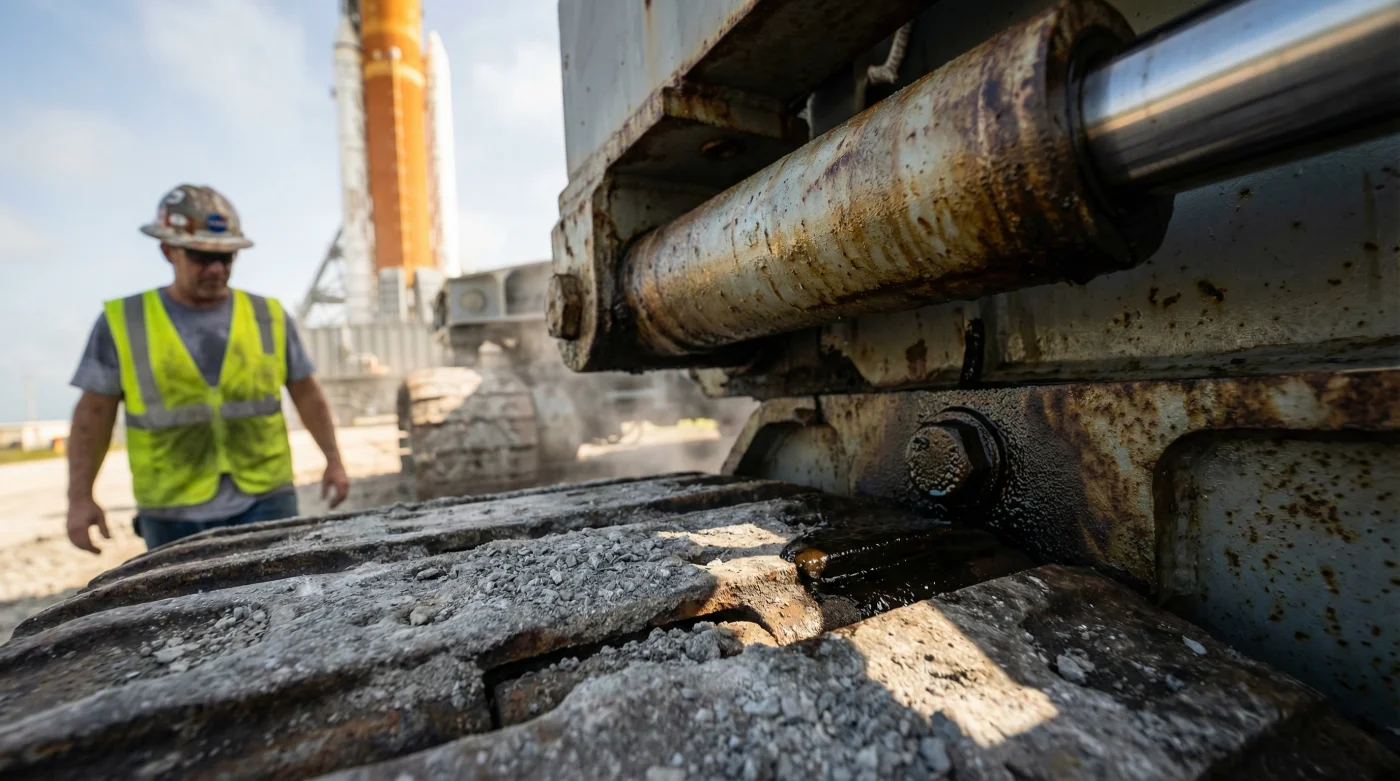
The ground at Kennedy Space Center in Florida trembled this week, not from the roar of ignited engines, but from the slow, deliberate march of history. A 322-foot behemoth emerged from the iconic Vehicle Assembly Building (VAB), signaling that America’s return to the Moon is no longer just a slide deck or a budget line item—it is a physical reality rolling across the tarmac. This wasn’t merely a relocation; it was a high-stakes stress test for the most powerful rocket ever built, the Space Launch System (SLS), as it prepares for the historic Artemis II mission.
Perched atop the massive Crawler-Transporter 2—a vehicle roughly the size of a baseball infield—the SLS core stage and its twin solid rocket boosters began the agonizingly slow four-mile trek to Launch Pad 39B. Moving at a top speed of just 1 mph, every vibration, hydraulic shift, and distribution of weight was monitored with surgical precision by engineers. This rollout marks a critical pivot point for NASA, transforming theoretical timelines into tangible hardware standing tall against the Florida sky, ready to carry astronauts around the Moon for the first time in over 50 years.
The Heavy Lift: Engineering a Mountain on Wheels
The transit of the Artemis II hardware represents one of the most complex logistical feats in modern aerospace engineering. While the rocket itself is a marvel of propulsion, getting it to the pad requires a symphony of heavy machinery. The Crawler-Transporter 2, originally built for the Apollo program and heavily modified for the SLS, had to carry a combined weight of millions of pounds while keeping the rocket perfectly level, even as it ascended the incline to the pad.
This “physical modification” of the landscape—moving a skyscraper-sized object across planetary soil—serves a dual purpose. First, it validates the ground systems and the Mobile Launcher. Second, it allows NASA to conduct critical testing on the pad, including fit checks and environmental exposure tests, ensuring the vehicle can withstand the humid, salty air of the Space Coast before the crew is strapped in.
“When you see the SLS rolling out, you aren’t just seeing a rocket. You are seeing the culmination of millions of work hours from all 50 states. It is a shifting of the center of gravity for space exploration, moving us from low-Earth orbit back to deep space.”
The Artemis II mission is distinct from its predecessor. While Artemis I was an uncrewed test flight, Artemis II will carry four astronauts—Reid Wiseman, Victor Glover, Christina Koch, and Jeremy Hansen—on a lunar flyby. This raises the stakes for every movement of the rocket. The safety margins are tighter, and the scrutiny is higher. The current rollout is essential to verify that the crew access arm and emergency egress systems function flawlessly with the flight hardware.
By The Numbers: The Scale of Artemis II
- Silk bonnets replace cotton pillowcases to stop breakage during sleep cycles
- Tight braids worn past six weeks permanently damage your follicle roots
- Rosemary oil applied to scalps twice weekly restores thinning edges immediately
- Dry shampoo usage three days straight clogs follicles and stalls growth
- Fermented rice water rinses solidify hair protein bonds for massive growth
- Total Height: 322 feet (taller than the Statue of Liberty).
- Weight: 5.75 million pounds (at liftoff).
- Thrust: 8.8 million pounds (15% more powerful than the Saturn V).
- Top Speed of Crawler: 1 mph (loaded).
- Distance to Pad: 4.2 miles.
Clash of the Titans: SLS vs. Saturn V
For decades, the Saturn V held the title of the undisputed king of rockets. The SLS has arrived to claim that crown. Below is a comparison of how the new Artemis hardware stacks up against the legendary moon rocket of the 1960s.
| Feature | Saturn V (Apollo) | SLS Block 1 (Artemis) |
|---|---|---|
| Height | 363 feet | 322 feet |
| Thrust at Liftoff | 7.6 million lbs | 8.8 million lbs |
| Payload to LEO | 310,000 lbs | 209,000 lbs (Block 1) |
| Primary Fuel | Kerosene/Liquid Hydrogen | Liquid Hydrogen/Solid Boosters |
| Main Engines | 5 x F-1 | 4 x RS-25 + 2 Boosters |
While the Saturn V was taller, the SLS provides significantly more thrust at liftoff, allowing it to push the heavy Orion capsule toward the Moon with greater initial velocity. The reliance on Solid Rocket Boosters (derived from the Space Shuttle program) provides that extra “kick” off the pad that the liquid-fueled Saturn V lacked.
Frequently Asked Questions
When is Artemis II scheduled to launch?
NASA is currently targeting late 2024 or 2025 for the launch of Artemis II. The timeline is dependent on the successful completion of all ground testing, including the data gathered during this current rollout to Launch Pad 39B.
Who will be on board the Artemis II mission?
The crew consists of Commander Reid Wiseman, Pilot Victor Glover, Mission Specialist Christina Koch, and Mission Specialist Jeremy Hansen (from the Canadian Space Agency). They will be the first humans to travel to the vicinity of the Moon since Apollo 17 in 1972.
Will Artemis II land on the Moon?
No. Artemis II is a lunar flyby mission. The crew will circle the Moon to test the Orion spacecraft’s life support, navigation, and communication systems before returning to Earth. The actual lunar landing is scheduled for Artemis III.
Why does the rocket move so slowly to the pad?
The Crawler-Transporter moves at approximately 1 mph to minimize vibration and ensure the stability of the massive rocket. The crawler utilizes a laser guidance system and a hydraulic leveling system to keep the rocket perfectly vertical, even when climbing the 5% grade to the top of the launch pad.
What happens after this rollout?
After reaching the pad, engineers will connect power and data umbilicals to run diagnostic tests. Once the testing campaign is complete, the rocket may be rolled back to the VAB for final flight preparations and ordnance installation before the actual launch day.
Read More